
“Y” Type vs “T” Type Strainer – Key Differences, Applications and Selection Guide
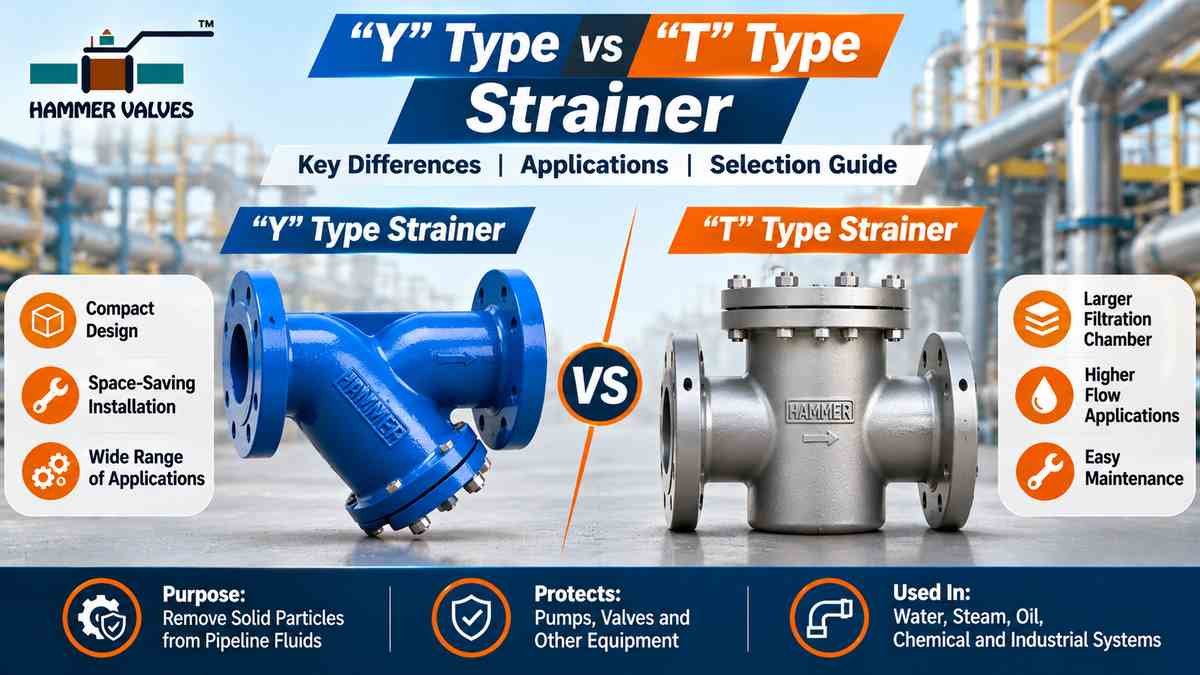
Industrial pipelines carry different types of fluids, including water, oil, steam, chemicals and other process media. During operation, unwanted particles such as rust, dirt, scale, welding slag and other solid impurities can enter the pipeline. These contaminants may damage pumps, control valves, flow meters and other equipment.
To protect pipeline components and maintain smooth system operation, industries use strainers.
Two commonly used designs are Y Type Strainers and T Type Strainers. Both are mechanical filtration devices designed to remove solid particles from flowing fluids. However, their body construction, filtration capacity, installation requirements and applications are different.
Understanding the difference between Y type and T type strainers helps engineers, maintenance teams and industrial buyers select the right filtration solution for their pipeline requirements.
In this guide, we explain how Y type and T type strainers work, their key differences, advantages, applications and the important factors to consider before selecting one.
What Is an Industrial Strainer?
An industrial strainer is a mechanical filtration device installed in a pipeline to remove unwanted solid particles from flowing fluids.
It generally consists of a body and a removable perforated screen or mesh element. As fluid passes through the strainer, solid contaminants are trapped inside the screen while the filtered fluid continues through the pipeline.
Strainers help protect sensitive equipment and reduce the possibility of damage caused by foreign particles.
Main Components of an Industrial Strainer
- Strainer body: The main housing through which fluid flows.
- Screen or mesh: Captures solid particles from the fluid.
- Cover: Provides access to the screen for inspection and cleaning.
- Gasket: Helps create a sealed connection between the body and cover.
- Drain or blowdown connection: Available on selected designs to remove accumulated debris.
- End connections: Connect the strainer to the pipeline.
Strainers are commonly used in water treatment plants, chemical industries, power plants, oil and gas facilities, HVAC systems, refineries and general industrial applications.
Explore the industrial strainers range from C.P. Valves Industry.
What Is a Y Type Strainer?
A Y type strainer is a pipeline filtration device with a body designed in the shape of the letter “Y”. It contains a removable screen that captures unwanted solid particles from the flowing fluid.
The angled chamber provides space for collecting debris while allowing the filtered fluid to continue through the pipeline.
Y type strainers are widely used in applications where a compact filtration arrangement is required.
How Does a Y Type Strainer Work?
The working principle of a Y type strainer is simple.
- Unfiltered fluid enters through the inlet connection.
- The fluid passes through the internal screen.
- Solid particles are trapped inside the screen.
- Filtered fluid flows through the outlet.
- Accumulated debris is removed during maintenance by opening the cover and cleaning the screen.
Some designs also include a blowdown connection that allows accumulated debris to be discharged without completely removing the screen.
Key Features of Y Type Strainers
1. Compact Design
The angled body design makes Y type strainers suitable for pipeline installations where available space is limited.
2. Removable Screen
The screen can generally be removed for inspection, cleaning and replacement.
3. Versatile Applications
Y type strainers are available in designs suitable for different fluids, pressure conditions and industrial applications.
4. Horizontal and Vertical Installation Options
Depending on the design and manufacturer’s instructions, Y type strainers can be installed in horizontal pipelines or vertical pipelines with downward flow.
5. Suitable for Different Fluids
They are used in selected water, oil, gas, steam and other industrial services, provided the body and screen materials are suitable for the application.
Common Applications of Y Type Strainers
- Water treatment plants
- Steam pipelines
- Oil and gas systems
- Chemical processing plants
- HVAC and cooling systems
- Pump suction and discharge lines
- Industrial utility pipelines
What Is a T Type Strainer?
A T type strainer is an industrial filtration device with a T-shaped body arrangement. It is designed to remove solid particles from flowing fluids using an internal screen or filtration element.
Its construction generally provides a larger screen chamber compared with a compact Y type design of similar pipeline size, although actual filtration capacity depends on the model and screen configuration.
T type strainers are often considered for applications involving higher flow requirements, larger pipelines or installations where additional screen area is beneficial.
How Does a T Type Strainer Work?
The working principle is similar to that of a Y type strainer.
- Unfiltered fluid enters the strainer body.
- The fluid passes through the internal filtration screen.
- Solid contaminants are retained by the screen.
- Filtered fluid exits through the outlet.
- Collected debris is removed during scheduled maintenance.
Depending on the construction, T type strainers may provide access through a removable cover or another maintenance arrangement.
Key Features of T Type Strainers
1. Larger Filtration Chamber
Many T type designs provide a larger chamber for accommodating a screen element.
2. Higher Flow Applications
Selected T type designs can be suitable for applications requiring higher flow capacity, depending on screen area and pressure-drop requirements.
3. Maintenance Access
Their construction can provide convenient access to the internal screen for inspection and cleaning.
4. Different Pipeline Arrangements
T type strainers are available in different configurations to suit specific pipeline layouts and engineering requirements.
5. Industrial Applications
They are used in selected water, chemical, oil, gas and other process applications.
Common Applications of T Type Strainers
- Large industrial pipelines
- Water distribution systems
- Chemical processing facilities
- Power plants
- Oil and gas installations
- Cooling water systems
- Industrial process pipelines
Y Type vs T Type Strainer: Key Differences
Both Y type and T type strainers perform the same basic function of removing unwanted particles from flowing fluids. However, their body design and application requirements can differ.
The following table highlights their main differences.
| Comparison factor | Y Type Strainer | T Type Strainer |
|---|---|---|
| Body design | Y-shaped body | T-shaped body |
| Construction | Compact design | Generally larger chamber design |
| Screen arrangement | Screen fitted in angled chamber | Screen fitted in the filtration chamber |
| Installation space | Generally requires less space | May require more installation space |
| Filtration area | Depends on screen design and size | Often provides a larger screen area in comparable applications |
| Flow capacity | Suitable for a wide range of pipeline flows | Selected designs suit higher-flow applications |
| Maintenance | Screen accessed through the cover | Screen accessed through the designed maintenance opening |
| Typical applications | Steam, water, oil and utility lines | Larger industrial and process pipelines |
| Selection priority | Compact installation and general filtration | Screen capacity, flow requirements and pipeline arrangement |
Note: These are general design comparisons. Actual dimensions, filtration area, flow capacity, pressure drop and maintenance requirements depend on the manufacturer’s design and technical specifications.
Advantages of Y Type Strainers
Y type strainers are widely used because of their compact design and versatile installation options.
1. Space-Saving Construction
Their angled body design makes them useful for installations where pipeline space is limited.
2. Versatile Industrial Use
They are available for different applications involving water, steam, oil and other suitable fluids.
3. Easy Screen Maintenance
The removable screen allows accumulated particles to be inspected and cleaned.
4. Multiple Installation Options
Depending on the design, Y type strainers can be installed in horizontal and certain vertical pipeline arrangements.
5. Suitable for Steam Applications
Y type strainers are commonly used in steam pipelines when the body, screen and connections are designed for the operating temperature and pressure.
Advantages of T Type Strainers
T type strainers can offer practical benefits in applications that require a different filtration chamber arrangement.
1. Larger Screen Options
Many T type designs can accommodate larger screen elements, providing additional filtration area.
2. Suitable for Larger Pipelines
Selected T type configurations are designed for larger pipeline sizes and industrial flow requirements.
3. Maintenance Access
The screen can be accessed through the designated cover or opening for cleaning and inspection.
4. Flexible Design Options
Different T type configurations can be selected according to pipeline layout and process requirements.
5. Suitable for Selected High-Flow Services
A properly designed T type strainer may be suitable for higher-flow applications when its screen area and pressure-drop characteristics meet the system requirements.
Disadvantages of Y Type and T Type Strainers
Both designs have limitations that should be considered before selection.
Limitations of Y Type Strainers
- The screen chamber may have less debris-holding capacity than some larger strainer designs.
- Frequent cleaning may be required when the fluid contains a high concentration of solid particles.
- Access to the screen may be difficult in certain installation arrangements.
- Pressure drop can increase as debris accumulates inside the screen.
Limitations of T Type Strainers
- Some designs require more installation space.
- Their initial cost may be higher depending on size and construction.
- Large or heavy screen assemblies may require additional maintenance planning.
- Installation and removal arrangements should be considered during pipeline design.
Which Is Better: Y Type or T Type Strainer?
There is no single best strainer for every industrial application. The correct choice depends on the fluid, flow rate, particle concentration, available space, pressure drop and maintenance requirements.
Choose a Y Type Strainer when:
- You need a compact filtration device.
- Installation space is limited.
- The pipeline carries steam, water, oil or another suitable fluid.
- The required filtration capacity can be achieved with the selected screen.
- The pipeline arrangement supports convenient screen maintenance.
Choose a T Type Strainer when:
- The application requires a larger filtration chamber.
- A larger screen area is beneficial.
- The pipeline has sufficient installation and maintenance space.
- The flow rate and debris load require a suitable larger-capacity design.
- The manufacturer’s pressure-drop and flow data support the application.
Before making the final decision, compare the technical datasheets of both designs.
How to Select the Right Industrial Strainer?
Selecting an industrial strainer requires careful evaluation of pipeline conditions. The following factors can help you make the right decision.
1. Identify the Fluid Type
Determine which fluid will pass through the strainer.
Common examples include:
- Water
- Steam
- Oil
- Gas
- Chemicals
- Cooling water
- Industrial process fluids
The strainer body, screen and gasket materials must be compatible with the fluid.
2. Check the Operating Pressure
Identify the normal operating pressure and maximum design pressure of the pipeline.
Select a strainer with a suitable pressure rating and confirm its allowable working pressure at the operating temperature.
3. Consider Operating Temperature
Temperature can affect the strength of the body material and the performance of the gasket and screen assembly.
For steam and high-temperature applications, verify the manufacturer’s pressure-temperature limitations.
4. Select the Correct Mesh or Perforation Size
The screen opening determines the size of particles that can be retained.
A finer screen can capture smaller particles, but it may also increase pressure drop and require more frequent cleaning.
Select the screen opening according to the protection requirements of downstream equipment.
5. Evaluate Flow Rate and Pressure Drop
The strainer should provide sufficient filtration area without creating an unacceptable pressure drop.
Consider the normal and maximum flow rates, screen open area and expected debris accumulation.
6. Check Material Compatibility
Common body materials may include cast iron, ductile iron, cast steel, stainless steel and other materials, depending on the product design.
Screen and gasket materials should also be suitable for the fluid and operating temperature.
7. Consider Maintenance Requirements
Check how easily the screen can be removed, inspected and cleaned.
Provide adequate clearance around the strainer for maintenance activities.
8. Verify Connection Standards
Confirm the required connection type, pressure designation, flange dimensions and applicable standards.
The selected strainer must be compatible with the existing pipeline.
Why Are Industrial Strainers Important for Pipeline Protection?
Strainers play an important role in protecting industrial equipment and supporting reliable pipeline operation.
1. Protect Pumps
Solid particles can damage pump components and affect performance. A suitable strainer can help prevent unwanted debris from entering the pump.
2. Protect Control Valves
Foreign particles may interfere with valve operation and damage internal sealing surfaces. Strainers help reduce the entry of contaminants into downstream valves.
3. Reduce Equipment Maintenance
By capturing solid contaminants, strainers can help reduce wear and maintenance requirements for connected equipment.
4. Support Smooth Process Operation
Clean fluid helps protect sensitive equipment and supports more consistent operation of industrial systems.
5. Reduce the Risk of Pipeline Blockage
Accumulated debris can restrict flow and increase pressure drop. Proper strainer selection and scheduled cleaning help manage this risk.
Applications of Y Type and T Type Strainers Across Industries
Both strainer designs are used in different industrial sectors according to their construction and operating specifications.
| Industry | Typical applications |
|---|---|
| Water treatment | Removing solid particles from water pipelines |
| Oil and gas | Protecting pumps and downstream equipment |
| Chemical processing | Removing unwanted particles from process fluids |
| Power plants | Filtering water and suitable utility fluids |
| HVAC | Protecting cooling and heating equipment |
| Pharmaceutical | Filtration of suitable utility and process fluids |
| Food and beverage | Protecting equipment in compatible process systems |
| Textile | Filtering industrial water and utility lines |
| Paper and pulp | Removing contaminants from selected process streams |
The final selection should always consider fluid properties, filtration requirements and the manufacturer’s technical specifications.
Why Choose C.P. Valves Industry for Industrial Strainers?
C.P. Valves Industry has been serving the valve industry since 1963, providing industrial flow control solutions for different applications.
Under its HAMMER brand, the company offers a range of industrial valve products and pipeline solutions.
Industrial strainers are important components in systems where downstream equipment needs protection from solid contaminants.
When selecting a strainer, consider the pipeline size, fluid type, operating pressure, temperature, screen specification and maintenance requirements.
Explore the HAMMER Industrial Strainer range to learn more about the available products.
For product enquiries and technical requirements, contact the C.P. Valves Industry team.
Frequently Asked Questions (FAQs)
1. What is the main difference between Y type and T type strainers?
The main difference is their body construction and screen arrangement. Y type strainers have an angled Y-shaped chamber, while T type strainers have a T-shaped body arrangement. Their filtration capacity and pressure drop depend on the specific design.
2. Which strainer is better for industrial applications?
Both designs are suitable for industrial applications. Y type strainers are commonly selected for compact installations, while selected T type designs are considered when a larger filtration chamber or screen area is required.
3. Can a Y type strainer be used in steam pipelines?
Yes. Y type strainers are commonly used in steam pipelines when their body material, screen, gasket, pressure rating and temperature limits are suitable for the application.
4. What is the purpose of a T type strainer?
A T type strainer removes solid contaminants from flowing fluids. Its design can accommodate different screen arrangements and may provide a larger filtration chamber for selected industrial applications.
5. How often should an industrial strainer be cleaned?
Cleaning frequency depends on fluid cleanliness, particle concentration, flow rate and screen size. Monitoring the pressure drop across the strainer can help determine when cleaning is required.
6. What is the difference between a strainer and a filter?
A strainer generally uses a perforated screen or mesh to remove relatively larger solid particles. A filter may use finer filtration media to capture smaller particles. The exact distinction depends on the equipment design and application.
7. How do I select the correct mesh size for a strainer?
Select the mesh or perforation size according to the particle size that needs to be removed and the protection requirements of downstream equipment. Also consider the pressure drop and cleaning frequency associated with finer screens.
8. Which materials are used to manufacture industrial strainers?
Depending on the application and design, industrial strainers may be manufactured using cast iron, ductile iron, carbon steel, stainless steel and other suitable materials. Screen and gasket materials must also be compatible with the operating fluid and temperature.
Conclusion
Y type and T type strainers are important filtration components used to protect industrial pipelines and downstream equipment from unwanted solid particles.
Y type strainers are generally preferred for compact installations and a wide range of utility applications. T type strainers may be suitable for applications requiring a larger filtration chamber or additional screen area.
However, the right choice depends on more than body shape. Fluid type, operating pressure, temperature, flow rate, screen size, pressure drop and maintenance requirements must all be considered.
Selecting the correct industrial strainer helps protect connected equipment, manage contamination and support reliable pipeline operation.
Looking for a suitable industrial strainer for your application? Explore the C.P. Valves Industry Strainer range and contact the team for product-related enquiries.


