
Wafer Type vs Lug Type Butterfly Valve – Key Differences, Applications and Selection Guide
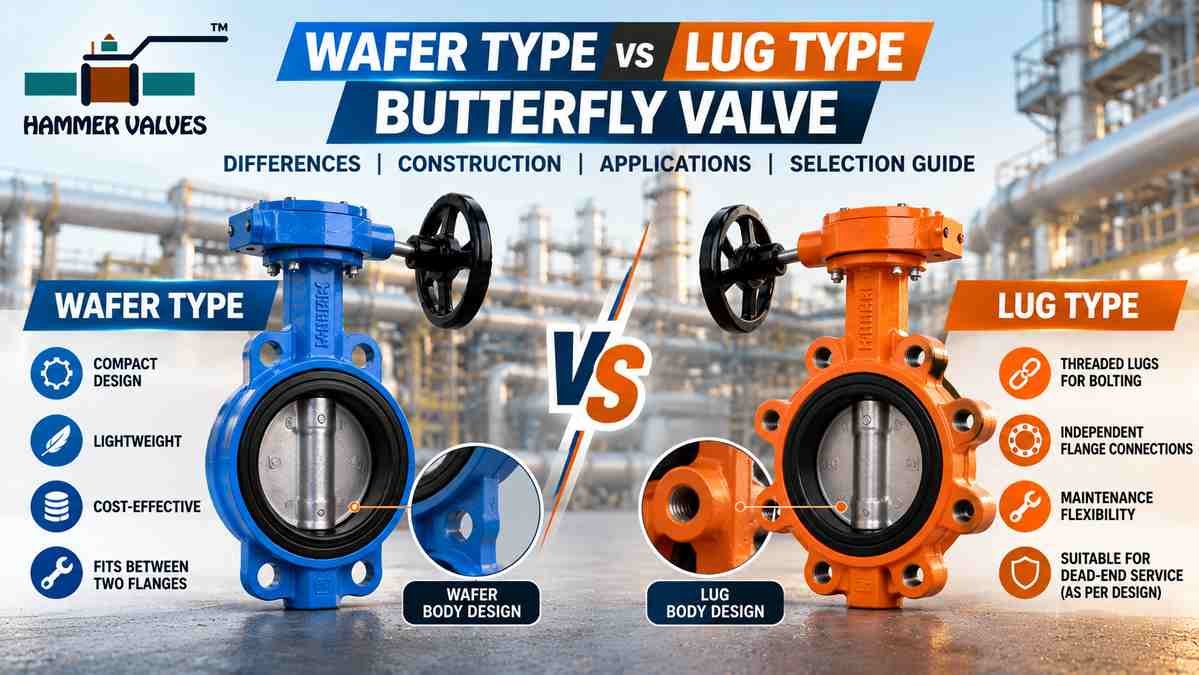
Butterfly valves are widely used in industrial pipelines for flow control and isolation. They are known for their compact design, lightweight construction, quick operation and suitability for different industrial applications.
When selecting a butterfly valve, two commonly available designs are wafer type and lug type. Although both use a rotating disc to control fluid flow, their body construction, installation methods and piping arrangements are different.
Understanding the difference between wafer type and lug type butterfly valves helps engineers, maintenance teams and industrial buyers select the right valve for their pipeline requirements.
In this guide, we will explain how wafer type and lug type butterfly valves work, compare their features, discuss their applications and help you choose the right design for your industrial system.
What Is a Butterfly Valve?
A butterfly valve is a quarter-turn valve used to start, stop or regulate the flow of liquids and gases in a pipeline.
It consists of a circular disc mounted on a rotating shaft inside the valve body. When the handle, gearbox or actuator rotates the shaft by approximately 90 degrees, the disc changes position and controls the flow.
Main components of a butterfly valve include:
- Valve body
- Disc
- Stem or shaft
- Seat or liner
- Operating handle or gearbox
- Actuator, where applicable
Butterfly valves are commonly used in water treatment plants, chemical industries, HVAC systems, power plants, pharmaceutical facilities, oil and gas installations and general industrial pipelines.
Explore the industrial butterfly valve range from C.P. Valves Industry.
What Is a Wafer Type Butterfly Valve?
A wafer type butterfly valve is designed to fit between two pipeline flanges. The valve body is held in position by the bolts connecting the two flanges.
It generally has a compact body without separate threaded lugs for independent flange bolting.
How Does a Wafer Type Butterfly Valve Work?
During installation, the wafer type butterfly valve is positioned between two pipeline flanges. Long bolts or studs pass through the flange assembly and secure the valve in place.
When the disc rotates:
- At 0 degrees, the disc is generally in the closed position.
- At approximately 90 degrees, the disc reaches the fully open position.
- At intermediate positions, the disc can regulate flow, subject to the valve’s design and operating limitations.
Key Features of Wafer Type Butterfly Valves
- Compact construction: Its body design makes it suitable for installations where space is limited.
- Lightweight design: Wafer valves are generally lighter than comparable lug type designs.
- Easy installation: The valve fits between two pipeline flanges.
- Cost-effective option: It can be an economical choice for many general-purpose applications.
- Space-saving: Its compact design is useful in crowded pipeline arrangements.
Common Applications of Wafer Type Butterfly Valves
- Water distribution systems
- Water treatment plants
- HVAC and cooling systems
- General industrial pipelines
- Irrigation systems
- Low and medium-pressure utility applications, where permitted by the product rating
What Is a Lug Type Butterfly Valve?
A lug type butterfly valve has threaded inserts or lugs around its body. These lugs allow the valve to be bolted to the pipeline flanges.
Unlike a wafer type design, a lug type valve can be bolted independently to each flange, depending on its construction and the manufacturer’s installation instructions.
This design is useful in pipeline arrangements where independent flange connections or maintenance access are required.
How Does a Lug Type Butterfly Valve Work?
The operating principle is similar to a wafer type butterfly valve. A disc rotates inside the valve body to control the flow of fluid.
The main difference is the body construction and flange connection arrangement.
During installation, bolts connect the lugs on the valve body to the corresponding pipeline flanges. This creates a more independent bolted connection on each side of the valve.
Some lug type butterfly valves are specifically designed and rated for dead-end service or end-of-line applications. However, this capability is not universal. Always verify the manufacturer’s instructions and pressure rating before using a valve in this arrangement.
Key Features of Lug Type Butterfly Valves
- Threaded lug construction: The valve body contains threaded inserts or lugs for bolting.
- Independent flange connections: Each side can be connected separately to its respective flange.
- Maintenance flexibility: Certain pipeline arrangements allow one side to be disconnected while the valve remains secured to the other side.
- Potential dead-end capability: Some models are designed for dead-end service, subject to manufacturer approval.
- Robust installation arrangement: The bolted connections provide a practical solution for selected industrial pipeline systems.
Common Applications of Lug Type Butterfly Valves
- Industrial water pipelines
- Chemical processing plants
- Cooling water systems
- Industrial utility pipelines
- Selected process isolation systems
- Applications requiring independent flange connections
Wafer Type vs Lug Type Butterfly Valve: Key Differences
Both valve types perform similar flow-control functions, but their construction and installation methods are different.
The following table explains the major differences.
| Comparison factor | Wafer Type Butterfly Valve | Lug Type Butterfly Valve |
|---|---|---|
| Body design | Compact wafer-style body | Body with threaded lugs |
| Installation | Fitted between two flanges | Bolted to each flange |
| Flange connection | Commonly uses through-bolts or studs | Uses bolts engaging the valve lugs |
| Weight | Generally lighter | Generally heavier |
| Cost | Often more economical | Often more expensive |
| Maintenance | Pipeline arrangement may require both sides to be disconnected | Can allow one side to be disconnected in suitable arrangements |
| Dead-end service | Generally not suitable unless specifically designed and approved | Some designs support dead-end service |
| Space requirement | Compact | May require more space for bolting |
| Typical use | General pipeline installations | Applications requiring independent flange connections |
Note: Actual dimensions, installation requirements, dead-end suitability and pressure limits depend on the specific valve design and manufacturer.
Advantages of Wafer Type Butterfly Valves
Wafer type butterfly valves are popular because of their simple construction and compact installation.
1. Economical design
Wafer type valves are often more affordable than comparable lug type valves, making them suitable for projects where cost optimisation is important.
2. Lightweight construction
Their relatively lightweight body can simplify handling and installation.
3. Compact installation
They require less space and are useful in pipeline systems with limited installation clearance.
4. Suitable for general pipeline applications
They are commonly used in water distribution, HVAC and other utility systems where their technical specifications meet the operating requirements.
Disadvantages of Wafer Type Butterfly Valves
Despite their advantages, wafer type butterfly valves have certain limitations.
- They depend on the two-flange assembly for installation.
- Removing the valve may require disconnecting the pipeline flange arrangement.
- They are generally not the preferred choice for applications requiring independent flange removal or dead-end service.
- Their suitability depends on the pipeline configuration and manufacturer specifications.
Advantages of Lug Type Butterfly Valves
Lug type butterfly valves offer greater flexibility in certain pipeline arrangements.
1. Independent flange bolting
The threaded lugs allow each side of the valve to be connected independently to its corresponding flange.
2. Easier maintenance in suitable arrangements
The valve can remain secured to one side while the other side is disconnected, provided the installation design and operating conditions allow it.
3. Dead-end service options
Certain lug type models are designed for dead-end applications. This feature must be confirmed from the manufacturer’s technical documentation.
4. Suitable for selected industrial applications
They can be a practical option for industrial systems that require independent flange connections.
Disadvantages of Lug Type Butterfly Valves
- Generally more expensive than comparable wafer type valves.
- Their construction may result in higher weight.
- Installation requires correct bolt selection and tightening.
- Not every lug type valve is approved for dead-end service.
- Maintenance must follow the manufacturer’s isolation and safety instructions.
Which Butterfly Valve Is Better: Wafer Type or Lug Type?
There is no single answer for every industrial application. The correct choice depends on the pipeline design, installation arrangement, maintenance requirements and operating conditions.
Choose a wafer type butterfly valve when:
- You need a compact valve design.
- The valve will be installed between two flanges.
- Both pipeline sides can be isolated and disconnected when required.
- A cost-effective solution is preferred.
- The application does not require independently bolted flange connections.
Choose a lug type butterfly valve when:
- Independent bolting to each flange is required.
- The pipeline arrangement needs greater maintenance flexibility.
- One side may need to be disconnected while the valve remains secured to the other side.
- The selected model is approved for the required dead-end service, if applicable.
Before finalising the selection, compare the manufacturer’s technical specifications rather than choosing only on price or body type.
Wafer vs Lug Butterfly Valve: How to Select the Right One?
Selecting the right butterfly valve requires careful consideration of the pipeline’s engineering requirements.
1. Check the Operating Pressure
Identify the normal operating pressure and maximum design pressure of the pipeline.
Choose a valve whose pressure rating is suitable for the complete operating range. Consider pressure surges and other transient conditions.
2. Consider the Operating Temperature
Temperature can affect the allowable working pressure and the performance of the valve seat and sealing materials.
Check the manufacturer’s pressure-temperature ratings before selecting the valve.
3. Identify the Fluid Type
The fluid passing through the pipeline affects material selection.
For example:
- Water applications may use suitable cast iron, ductile iron or other approved materials.
- Chemical applications may require corrosion-resistant body, disc and seat materials.
- Oil and gas applications require materials and designs suitable for the specific service conditions.
- Food and pharmaceutical applications may have additional hygiene and material requirements.
4. Check the Pipeline Flange Standard
Verify the flange standard, pressure designation, dimensions, facing and bolt arrangement.
The selected butterfly valve must be compatible with the existing pipeline connection.
5. Review Maintenance Requirements
If the pipeline requires independent flange disconnection, a suitable lug type design may be preferable.
For simpler installations where the pipeline can be disconnected from both sides, a wafer type design may be sufficient.
6. Verify Dead-End Service Requirements
If the valve will be installed at the end of a pipeline, confirm whether the selected model is rated for dead-end service.
Do not assume that every lug type butterfly valve supports this arrangement.
7. Consult the Manufacturer’s Datasheet
Before placing an order, confirm:
- Valve size and dimensions
- Pressure rating
- Operating temperature
- Body material
- Disc material
- Seat material
- Flange compatibility
- Operating mechanism
- Applicable design and testing standards
- Dead-end service limitations, where relevant
Industries Using Wafer and Lug Type Butterfly Valves
Both wafer and lug type butterfly valves are used across different industries, depending on their design and technical specifications.
| Industry | Common applications |
|---|---|
| Water treatment | Water distribution and treatment pipelines |
| Chemical industry | Process fluid isolation and control |
| HVAC | Chilled water and cooling systems |
| Oil and gas | Selected utility and process pipelines |
| Power plants | Cooling water and utility services |
| Pharmaceutical | Process and utility piping |
| Food and beverage | Suitable process and utility lines |
| Textile | Industrial water and utility systems |
| Fire protection | Approved systems and applications, as per applicable standards |
The valve type, material and pressure rating must always match the specific application requirements.
Why Choose C.P. Valves Industry for Butterfly Valves?
C.P. Valves Industry has been serving the valve industry since 1963, offering industrial valve solutions for different applications.
Under its HAMMER brand, the company provides a range of industrial valves for multiple sectors and pipeline requirements.
Its product range includes:
- Butterfly Valves
- Ball Valves
- Gate Valves
- Globe Valves
- Strainers
- Non-Return Valves
- Foot Valves
- Air Vent Valves
- Pressure Reducing Valves
If you are looking for industrial butterfly valves, explore the C.P. Valves Industry Butterfly Valve range or visit the HAMMER Valves product range.
Contact the C.P. Valves Industry team to discuss your valve requirements and identify a suitable product for your application.
Frequently Asked Questions (FAQs)
1. What is the main difference between wafer and lug type butterfly valves?
The main difference is their body construction and installation method. A wafer type valve is fitted between two pipeline flanges, while a lug type valve has threaded lugs that allow it to be bolted independently to each flange.
2. Which butterfly valve is more economical?
Wafer type butterfly valves are generally more economical than comparable lug type designs. However, the final price depends on valve size, pressure rating, material and manufacturer.
3. Can a lug type butterfly valve be used for dead-end service?
Some lug type butterfly valves are designed for dead-end service, but not all models support it. Always check the manufacturer’s technical datasheet for the permitted pressure and installation conditions.
4. Can wafer type butterfly valves be used in industrial applications?
Yes. Wafer type butterfly valves are widely used in industrial water, HVAC, utility and other pipeline applications when their pressure, temperature and material specifications are suitable.
5. Which butterfly valve is easier to maintain?
A lug type valve can offer maintenance flexibility because each flange connection is independent. However, actual maintenance requirements depend on the pipeline layout, isolation arrangement and manufacturer’s instructions.
6. Are wafer and lug type butterfly valves available in different materials?
Yes. Depending on the manufacturer and model, they may be available with different body, disc and seat materials, such as cast iron, ductile iron, carbon steel, stainless steel, EPDM and other suitable materials.
7. Which butterfly valve should I choose for my pipeline?
Choose according to operating pressure, temperature, fluid, pipeline flange standard, installation space and maintenance requirements. Consult the manufacturer’s technical team when the application involves critical service or dead-end installation.
Wafer type and lug type butterfly valves are both useful solutions for industrial pipeline systems. However, their installation methods, body construction and maintenance flexibility make them suitable for different requirements.
Wafer type butterfly valves are generally preferred for compact and economical installations, while lug type butterfly valves offer independent flange connections and can support certain maintenance and dead-end service arrangements when specifically designed for them.
Before selecting a butterfly valve, always check its pressure rating, temperature limits, material compatibility, flange dimensions and manufacturer’s technical specifications.
Looking for a suitable butterfly valve for your industrial application? Contact C.P. Valves Industry and explore the HAMMER range of industrial valves.


