
What Are IBR Approved Valves? Applications and Requirements
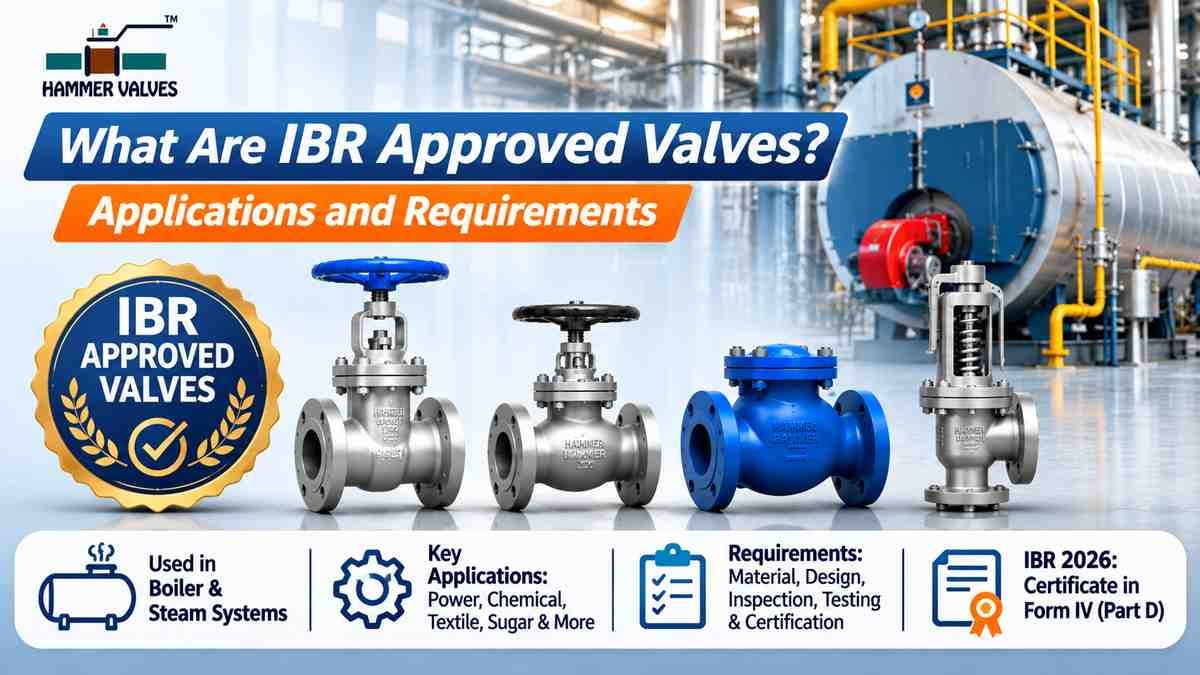
Industrial valves used in boiler systems and steam pipelines must meet specific safety and technical requirements. In India, these requirements are governed by the Indian Boiler Regulations (IBR), which cover the materials, design, construction, inspection and testing of boilers and relevant components.
IBR approved valves are valves that meet the applicable Indian Boiler Regulations requirements for their intended boiler or steam-piping application. They are used in systems where safe control of steam, boiler feedwater and other high-temperature or pressurised fluids is essential.
For boiler manufacturers, plant operators, maintenance engineers and procurement teams, understanding IBR requirements is important before purchasing valves.
In this guide, we explain what IBR approved valves are, where they are used, the applicable requirements, certification documents and the factors to consider when selecting them.
What Are IBR Approved Valves?
IBR stands for Indian Boiler Regulations. These regulations establish technical and inspection requirements for boilers and relevant boiler components used in India.
An IBR-compliant valve is designed, manufactured, inspected and tested in accordance with the applicable regulatory requirements for its intended service.
These valves are commonly required for specific boiler mountings, steam-pipe fittings and other components that fall within the scope of the regulations.
Unlike ordinary industrial valves, valves intended for IBR-regulated applications may require specific material traceability, design documentation, inspection records and certification.
It is important to understand that not every industrial valve needs IBR certification. The requirement depends on the application, the component’s function and whether it falls within the applicable regulatory scope.
What Is the Indian Boiler Regulation?
The Indian Boiler Regulations are issued by the Central Boilers Board under the authority of India’s boiler legislation. They establish requirements related to:
- Boiler and component materials.
- Design and construction.
- Manufacturing processes.
- Inspection during manufacture.
- Testing and certification.
- Boiler mountings and fittings.
- Steam-pipe systems and associated components.
Current regulatory update: The Indian Boiler Regulations, 2026 came into force on 1 October 2026 and superseded the Indian Boiler Regulations, 1950. The Boilers Act, 2025 provides the current legislative framework.
The updated regulations should be consulted when specifying new IBR-related valves and documentation. Older technical documents may still refer to IBR 1950 and its certificate forms, so buyers should verify the applicable requirements with the relevant Inspecting Authority and boiler inspector.
Why Are IBR Approved Valves Important?
Boiler and steam systems operate under pressure and often at elevated temperatures. A valve failure can result in steam leakage, equipment damage, production interruptions and serious safety risks.
IBR requirements help ensure that relevant components are manufactured and inspected according to defined technical and safety requirements.
The importance of IBR-compliant valves includes:
1. Safe Boiler Operation
Suitable valves help control steam, feedwater and other fluids in boiler systems. Compliance with applicable design and inspection requirements supports safe operation.
2. Material Quality and Traceability
Material selection is important for components exposed to pressure and temperature. Applicable material records help establish the identity and properties of the materials used.
3. Manufacturing and Testing Requirements
Relevant boiler components must meet applicable manufacturing, inspection and testing requirements. This helps identify defects that could affect component integrity.
4. Regulatory Compliance
Using the required compliant components helps boiler owners and project teams meet applicable statutory and inspection requirements.
5. Equipment Reliability
Correctly selected and manufactured valves can help maintain reliable operation when used within their specified pressure, temperature and service limits.
Types of Valves Used in IBR Applications
Different valves perform different functions in boiler and steam systems. The following are common examples.
1. Gate Valves
Gate valves are primarily used for isolating flow. A gate or wedge moves up and down to open or close the flow passage.
They are used in selected steam and water lines where full isolation is required.
Applications:
- Boiler steam lines.
- Main steam isolation.
- Industrial steam distribution.
- Boiler feedwater systems, where specified.
Explore HAMMER Gate Valves.
2. Globe Valves
Globe valves use a movable disc or plug to regulate flow through the valve. They are commonly selected for applications requiring flow control or isolation.
Applications:
- Steam pipelines.
- Boiler auxiliary lines.
- Process steam systems.
- Industrial utility services.
Explore HAMMER Globe Valves.
3. Non Return Valves
Non return valves, also called check valves, allow flow in one direction and prevent reverse flow.
They are used in suitable feedwater and other pipeline arrangements to prevent unwanted backflow.
Applications:
- Boiler feedwater lines.
- Pump discharge systems.
- Water circulation systems.
- Industrial fluid pipelines.
Explore HAMMER Non Return Valves.
4. Safety Valves
Safety valves are pressure-relieving devices designed to discharge steam when the pressure reaches the specified set pressure.
They are essential safety devices in boiler systems. Their design, capacity, setting and installation must meet the applicable regulatory requirements.
Applications:
- Steam boilers.
- Superheaters.
- Economisers, where applicable.
- Pressure-containing steam systems.
5. Feed Check Valves
Feed check valves are used in boiler feedwater systems. They help control the entry of feedwater into the boiler and prevent reverse flow towards the feed line.
Applications:
- Boiler feedwater systems.
- Industrial steam boilers.
- Power generation facilities.
6. Blowdown Valves
Blowdown valves are used to discharge water and accumulated solids from a boiler. They support boiler water management and help remove unwanted deposits.
Applications:
- Boiler bottom blowdown lines.
- Boiler water management systems.
- Industrial steam generation.
7. Angle Globe Valves
Angle globe valves are designed with inlet and outlet connections arranged at an angle. They are used in selected boiler and steam applications where the flow arrangement and installation requirements suit this configuration.
Applications:
- Boiler auxiliary systems.
- Steam distribution.
- Industrial process pipelines.
Important: The valve types listed above are examples of equipment used in boiler-related systems. The IBR status of a particular valve must be verified for its exact model, size, material, design and intended application. A valve should not be assumed to be IBR approved simply because it belongs to one of these categories.
IBR Approved Valve Applications
IBR-compliant valves are used in industrial systems where the applicable boiler and steam-piping requirements must be followed.
1. Industrial Boiler Systems
Industrial boilers use several types of valves to manage steam generation, feedwater supply, isolation and blowdown operations.
Common requirements include suitable steam stop valves, feed check valves and safety valves.
2. Power Plants
Power plants use high-pressure and high-temperature steam systems. Valves are required for isolation, flow control, feedwater and other auxiliary services.
The selected valve must meet the specified operating conditions and applicable regulatory requirements.
3. Chemical and Petrochemical Industries
Chemical and petrochemical facilities use steam for heating, processing and utility services. Valves in applicable boiler and steam-pipe systems must meet the required specifications.
Material compatibility is also important because some process environments may involve corrosive fluids.
4. Pharmaceutical Industries
Pharmaceutical manufacturing facilities use steam in utility and process-related applications. Valves must be selected according to the steam system’s pressure, temperature, cleanliness and regulatory requirements.
5. Textile Industries
Textile manufacturing uses steam for processes such as dyeing, drying and finishing. Suitable valves help manage steam distribution and isolation.
6. Sugar and Food Processing Industries
Sugar mills and food-processing plants use boilers and steam systems for heating, evaporation and other manufacturing operations.
Appropriate valves are required for safe steam distribution and boiler operation.
7. Refineries and Industrial Manufacturing
Refineries and manufacturing facilities use steam for heating, process operations and utility services. Valves in regulated boiler and steam-piping applications must be selected according to the relevant requirements.
IBR Approved Valve Requirements
IBR compliance involves more than selecting a valve with a suitable pressure rating. The component must meet the applicable requirements for design, materials, manufacturing, inspection, testing and certification.
The following areas should be checked.
1. Material Requirements
Valve materials must be suitable for the specified pressure, temperature and service conditions.
Depending on the valve design and application, materials may include:
- Carbon Steel.
- Alloy Steel.
- Stainless Steel.
- Cast Steel.
- Other permitted material grades.
The applicable regulation and material specification determine whether a particular grade is acceptable.
Material identification and traceability documents should be checked against the actual valve supplied.
2. Design and Construction
The valve design must meet the applicable requirements for its intended service.
Important considerations include:
- Valve body and pressure-containing components.
- Disc, seat and spindle arrangement.
- Pressure-temperature suitability.
- End connections and flange dimensions.
- Flow direction and operating indicators.
- Construction and assembly details.
The current IBR regulations also specify requirements relating to valve construction, moving parts, flanges, seatings and other details.
3. Manufacturing Inspection
Relevant components may be subject to inspection during manufacturing. The applicable inspection process depends on the component, its construction and the requirements of the regulations.
Manufacturing records and inspection documentation should be maintained.
4. Testing Requirements
Testing is important to confirm the integrity of pressure-containing components.
For example, IBR 2026 Regulation 191 specifies that completed valve chests and fittings must be hydraulically tested at a minimum of 1.5 times the maximum allowable working pressure of the valve for which they are intended.
Other applicable inspection and testing requirements must also be followed according to the valve design and service.
5. Certification and Documentation
The required certificates help establish that the relevant components have been manufactured and tested according to the applicable requirements.
Buyers should verify the certificates against the supplied product’s identification, size, material and other relevant details.
IBR Valve Certification: What Documents Should Buyers Check?
Documentation is an important part of purchasing valves for regulated boiler and steam-piping applications.
Under IBR 2026, Regulation 12 specifies a certificate of manufacture and test in Form IV (Part D), signed by the maker and the Inspecting Authority, for boiler mountings and steam-pipe fittings during manufacture.
Other documents may be relevant depending on the product and material.
Before accepting a valve, buyers should check:
- Manufacturing and test certificate: Confirm that the required certificate is available for the applicable component.
- Material test certificate: Verify the material grade and traceability information.
- Inspection records: Check the applicable inspection and testing details.
- Valve identification: Match the valve markings with the supplied documents.
- Technical datasheet: Verify size, pressure rating, temperature range and material.
- Approved drawings or design documents: Check where required for the application.
- Applicable regulatory form: Confirm that the certificate follows the current IBR requirements.
Important: IBR 2026 Certificate Form Update
Earlier documents under IBR 1950 commonly referred to Form III-C for boiler mountings and steam-pipe fittings.
Under IBR 2026, the corresponding manufacture and test certificate is specified as Form IV (Part D).
Procurement teams should avoid relying only on an old form reference when ordering new components. For existing stock, legacy certificates or transitional cases, confirm acceptance with the relevant Inspecting Authority or boiler inspector.
Difference Between IBR Approved Valves and Standard Industrial Valves
| Comparison Factor | IBR-Compliant Valves | Standard Industrial Valves |
|---|---|---|
| Main application | Applicable boiler and steam-piping services | General industrial applications |
| Regulatory requirements | Subject to applicable IBR provisions | Depends on the application and other applicable standards |
| Documentation | Specific IBR certificates may be required | Standard product and material documents as specified |
| Inspection | Applicable IBR inspection requirements | Manufacturer or project-specific inspection |
| Material selection | Must meet applicable IBR requirements | Based on service and specified standards |
| Testing | Applicable IBR testing requirements | Manufacturer and applicable product-standard requirements |
A standard industrial valve may be suitable for a particular pressure or temperature rating but still may not satisfy the regulatory requirements for an IBR-controlled application.
How to Select the Right IBR Approved Valve
Selecting the correct valve is important for safe and reliable boiler operation.
Consider the following points before placing an order.
1. Identify the Application
Determine whether the valve will be installed in a boiler mounting, feedwater line, steam pipeline, blowdown system or another application.
2. Confirm Pressure and Temperature
Share the design pressure, operating pressure and operating temperature. The valve must be suitable for the actual service conditions.
3. Select the Correct Valve Type
Choose the valve based on its function:
- Gate valve for isolation.
- Globe valve for suitable flow regulation and isolation.
- Non return valve for backflow prevention.
- Feed check valve for boiler feedwater service.
- Safety valve for pressure relief.
- Blowdown valve for boiler discharge.
4. Check Material Compatibility
Confirm the valve body, trim and sealing materials against the fluid and operating conditions.
5. Verify Certificates
Ask for the required IBR certificate and supporting documentation for the exact valve being supplied.
6. Check Installation Requirements
Confirm the flow direction, installation orientation, end connections and maintenance requirements.
7. Consult the Boiler Inspector or Project Engineer
For regulated installations, confirm the exact requirements with the responsible boiler inspector, Inspecting Authority or project engineering team before finalising the purchase.
Why Choose C.P. Valves Industry for IBR Approved Valves?
C.P. Valves Industry, established in 1963, is a manufacturer, distributor and exporter of industrial valves under its HAMMER brand and other recognised brands.
The company offers valve solutions for boiler systems, power plants, petrochemical facilities and other industrial applications.
Its website identifies IBR-approved HAMMER valves for applications including boiler systems, power plants and petrochemical processes.
The product range relevant to boiler applications includes:
- Gate Valves.
- Globe Valves.
- Non Return Valves.
- Safety Valves.
- Feed Check Valves.
- Blowdown Valves.
- Steam Traps.
- Pressure Reducing Valves.
- Angle Globe Valves.
- Gauge Glass Cocks.
- Moisture Separators.
- Fusible Plugs.
The suitability and IBR documentation of each product should be confirmed for the required model and application.
Explore the C.P. Valves Industry Boiler Industry product range to learn more about available valve solutions.
You can also explore:
Frequently Asked Questions About IBR Approved Valves
1. What does IBR stand for?
IBR stands for Indian Boiler Regulations. These regulations specify requirements for the materials, design, construction, inspection and testing of boilers and relevant components in India.
2. Are IBR approved valves mandatory for every industrial pipeline?
No. IBR requirements apply to components and applications falling within the scope of the applicable boiler regulations. Not every industrial pipeline or valve automatically requires IBR certification.
3. Which valves are commonly used in IBR boiler applications?
Common examples include steam stop valves, feed check valves, safety valves, blowdown valves, gate valves, globe valves and other relevant boiler mountings and steam-pipe fittings.
4. What is the current IBR certificate for boiler mountings and fittings?
Under IBR 2026, the certificate of manufacture and test for boiler mountings and steam-pipe fittings is Form IV (Part D), signed by the maker and the Inspecting Authority.
5. Is Form III-C still the current IBR certificate form?
Form III-C was associated with the earlier IBR 1950 framework. IBR 2026 superseded IBR 1950 from 1 October 2026 and specifies Form IV (Part D) for the relevant manufacture and test certificate. Verify legacy documentation and transitional cases with the responsible authority.
6. What documents should I request when purchasing an IBR valve?
Request the applicable IBR certificate, material test certificate, inspection and test records, technical datasheet and product identification details. The exact documents depend on the valve and its application.
7. What is the difference between IBR and ASME standards?
IBR is India’s regulatory framework for boilers and relevant components. ASME codes provide engineering requirements for pressure equipment and related components. Their roles are different, and compliance with one should not automatically be treated as compliance with the other.
8. Where are IBR approved valves used?
They are used in applicable boiler and steam systems across power plants, chemical and petrochemical facilities, textile mills, sugar factories, pharmaceutical facilities, refineries and other industrial plants.
Conclusion
IBR approved valves play an important role in boiler and steam-piping applications where regulatory compliance, material quality, manufacturing inspection and testing are essential.
Choosing the right valve requires checking its application, pressure and temperature ratings, materials, construction and certification documents. Buyers should also ensure that the documentation follows the current Indian Boiler Regulations, 2026 requirements.
C.P. Valves Industry offers HAMMER brand valve solutions for boiler and other industrial applications. Contact the team to discuss your valve requirements and confirm the applicable product specifications and documentation.
Contact C.P. Valves Industry
- Website: https://cpvalves.com/
- Phone: +91 22 6185 2865
- Email: cpvalvesind@hotmail.com
- WhatsApp: +91 98209 73712


