
How a Ball Valve Works: Working Principle, Components, Types and Applications
Ball valves are among the most widely used valves in industrial pipeline systems. They are known for their simple operating mechanism, reliable shut-off performance, compact design and quick operation.
You can find ball valves in water treatment plants, chemical industries, oil and gas facilities, power plants, pharmaceutical units and many other industrial applications.
But how does a ball valve actually work? What happens inside the valve when you turn its handle? How does the internal ball control the flow of liquid or gas?
In this guide, we explain how a ball valve works, its main components, operating principle, different types and applications across industries.
What Is a Ball Valve?
A ball valve is a type of quarter-turn valve that uses a hollow, perforated and rotating ball to control the flow of fluid through a pipeline.
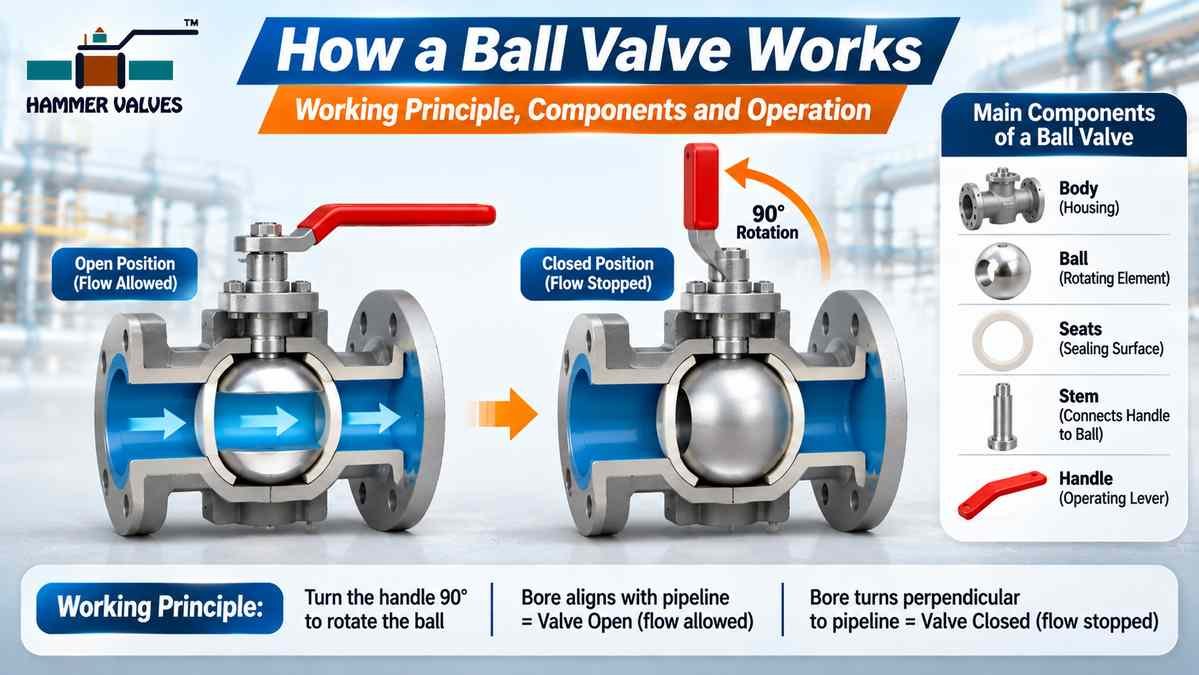
The ball is positioned inside the valve body and contains a hole known as a bore. When the bore aligns with the pipeline, fluid can pass through the valve. When the ball rotates and the bore moves perpendicular to the pipeline, the flow is blocked.
A ball valve generally requires a 90-degree rotation to move between fully open and fully closed positions.
Because of its simple design and quick operation, it is commonly used for on-off flow control and pipeline isolation.
Explore the industrial ball valves range from C.P. Valves Industry.
How Does a Ball Valve Work?
The working principle of a ball valve is based on the rotation of a spherical ball inside the valve body.
The ball is connected to an operating handle or actuator through a stem. When the operator turns the handle, the stem rotates the ball and changes the position of its internal bore.
A typical manually operated ball valve works in two main positions.
1. Ball Valve in the Open Position
When the handle is turned 90 degrees to the open position, the hole inside the ball aligns with the inlet and outlet ports of the valve.
This creates a passage for fluid to flow through the valve.
In a full-port ball valve, the bore is approximately the same diameter as the connecting pipeline, allowing a relatively unrestricted flow path.
What happens in the open position?
- The ball bore aligns with the pipeline.
- Fluid enters through the inlet.
- Fluid passes through the ball’s internal bore.
- Fluid exits through the outlet.
- The valve allows flow through the pipeline.
2. Ball Valve in the Closed Position
When the handle is rotated 90 degrees from the open position, the ball turns so that its bore is perpendicular to the direction of flow.
The solid surface of the ball blocks the pipeline passage, stopping the fluid flow.
What happens in the closed position?
- The ball rotates inside the valve body.
- The bore moves away from the flow direction.
- The solid section of the ball faces the pipeline ports.
- The valve seats provide sealing contact against the ball.
- Flow is stopped when the valve achieves its specified shut-off performance.
The valve’s sealing performance depends on its seat design, materials, pressure, temperature and operating conditions.
Working Mechanism of a Ball Valve
The operation of a ball valve involves several interconnected components.
When the handle or actuator is operated, the movement is transferred through the stem to the ball. The ball rotates inside the valve body while the seats maintain contact with its surface.
The following steps explain the mechanism:
- The operator turns the handle or activates the actuator.
- The stem transfers rotational movement to the ball.
- The ball rotates approximately 90 degrees.
- The ball bore either aligns with or blocks the pipeline passage.
- The valve seats help create a seal around the ball.
- The valve controls or stops the flow according to its position.
This quarter-turn mechanism makes ball valves suitable for applications requiring quick and reliable isolation.
Main Components of a Ball Valve
A ball valve consists of several components that work together to control fluid flow.
1. Valve Body
The valve body is the main external housing of the ball valve. It contains the internal components and provides connections to the pipeline.
Depending on the valve design, the body may be manufactured using cast iron, carbon steel, stainless steel, brass or other suitable materials.
2. Ball
The ball is the main flow-controlling component. It contains a hole or bore through which fluid passes when the valve is open.
The ball rotates to open or close the flow passage.
3. Stem
The stem connects the ball to the operating handle or actuator.
When the handle is turned, the stem transfers rotational movement to the ball.
4. Valve Seats
Valve seats are positioned around the ball to provide sealing contact.
Common seat materials include PTFE and other polymeric or elastomeric materials, depending on the valve design and application.
The selected seat material must be suitable for the operating pressure, temperature and fluid.
5. Handle
The handle is used to operate a manually controlled ball valve.
In standard manual quarter-turn designs, the handle position generally indicates whether the valve is open or closed.
6. Packing and Gland
The packing arrangement helps prevent leakage around the stem where it passes through the valve body.
The gland or gland arrangement maintains the required packing compression according to the valve design.
7. End Connections
End connections allow the ball valve to be connected to the pipeline.
Common connection types include threaded, flanged, socket-weld and butt-weld connections, depending on the model.
Different Types of Ball Valves
Ball valves are available in different designs according to their construction, number of ports, ball mounting arrangement and application requirements.
Understanding these types helps in selecting the right valve for an industrial pipeline.
1. Two-Way Ball Valve
A two-way ball valve has one inlet and one outlet.
It is the most common ball valve arrangement and is used to start or stop fluid flow through a pipeline.
Applications:
- Water pipelines
- Oil transfer systems
- Industrial utility lines
- Chemical process pipelines
- General pipeline isolation
2. Three-Way Ball Valve
A three-way ball valve has three ports and can be used to divert or mix flow, depending on its internal ball configuration.
Two common designs are:
L-Port Ball Valve: An L-shaped passage allows flow to be directed between selected ports. It is commonly used for flow diversion.
T-Port Ball Valve: A T-shaped passage can connect different combinations of ports and may be used for mixing or diverting flow.
The available flow paths depend on the valve’s design and operating position.
3. One-Piece Ball Valve
A one-piece ball valve has a body manufactured as a single main piece.
Its compact construction makes it suitable for selected general-purpose applications.
However, internal access and maintenance options can be limited compared with some multi-piece designs.
4. Two-Piece Ball Valve
A two-piece ball valve consists of two main body sections connected together.
This construction allows the internal components to be assembled within the body and provides different maintenance options depending on the design.
It is widely used in industrial and commercial pipeline systems.
5. Three-Piece Ball Valve
A three-piece ball valve consists of three main body sections, generally including a central body and two end connectors.
Many designs allow the central section to be removed for maintenance without disconnecting the end connections from the pipeline, subject to the manufacturer’s design and installation instructions.
6. Floating Ball Valve
In a floating ball valve, the ball is not fixed by trunnions. It is supported by the valve seats and can move slightly under pressure.
When pressure acts on the ball, it pushes the ball against the downstream seat to create a seal.
Floating ball valves are commonly used in applications within their specified pressure and size limits.
7. Trunnion Mounted Ball Valve
A trunnion mounted ball valve uses additional mechanical support to hold the ball in position.
The ball is supported by upper and lower trunnions, reducing the load transferred to the seats.
This design is commonly considered for larger sizes and higher-pressure applications, depending on the manufacturer’s specifications.
Ball Valve vs Other Types of Industrial Valves
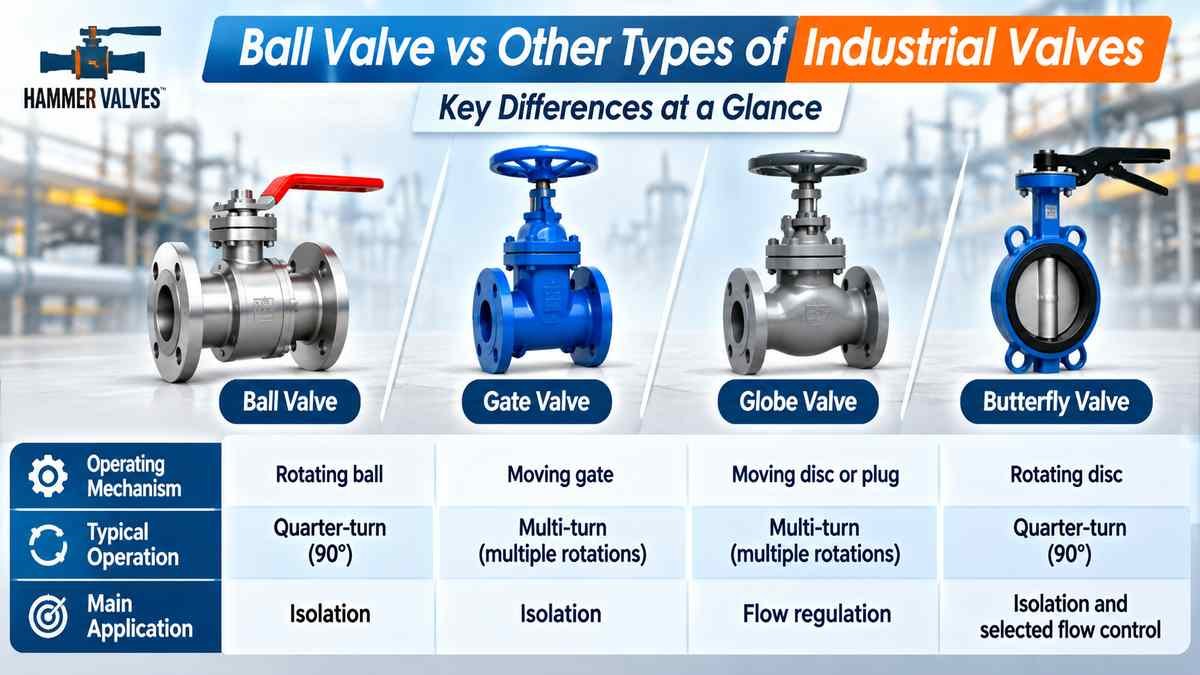
Different valve designs serve different purposes in industrial pipelines.
| Comparison factor | Ball Valve | Gate Valve | Globe Valve | Butterfly Valve |
|---|---|---|---|---|
| Operating mechanism | Rotating ball | Moving gate | Moving disc or plug | Rotating disc |
| Typical operation | Quarter-turn | Multi-turn | Multi-turn | Quarter-turn |
| Main application | Isolation | Isolation | Flow regulation | Isolation and selected flow control |
| Operating speed | Generally quick | Generally slower | Generally slower | Generally quick |
| Construction | Ball and seats | Gate and seats | Disc and seat | Disc and shaft |
| Typical use | Water, oil, gas and process lines | Pipeline isolation | Flow regulation | Water, HVAC and industrial pipelines |
The correct valve depends on the application, operating conditions and required flow-control function.
Materials Used in Ball Valve Manufacturing
Ball valves are manufactured using different materials to suit various industrial applications.
1. Cast Iron (CI)
Cast iron ball valves are used in selected general-purpose applications, depending on pressure, temperature and fluid requirements.
2. Mild Steel (MS)
Mild steel is used in selected industrial valve constructions where the mechanical and corrosion requirements are suitable.
3. Carbon Steel (CS)
Carbon steel ball valves are commonly considered for industrial services that require suitable strength and pressure capability.
4. Stainless Steel SS304
SS304 is used in applications where corrosion resistance and material compatibility are important.
5. Stainless Steel SS316
SS316 contains molybdenum and generally offers better resistance to certain corrosive environments than SS304. Actual suitability depends on the fluid, concentration and operating conditions.
6. Brass and Bronze
Brass and bronze ball valves are used in selected water, utility and general industrial applications.
7. Plastic Materials
Ball valves made from materials such as polypropylene (PP) and high-density polyethylene (HDPE) are used in selected chemical, water and utility applications.
The body material, ball, stem and seat materials should all be checked before selecting a valve.
Applications of Ball Valves Across Industries
Ball valves are used in a wide range of industrial sectors because of their simple operation and effective isolation capabilities.
| Industry | Applications |
|---|---|
| Oil and gas | Pipeline isolation and fluid transfer |
| Chemical | Process fluid isolation |
| Water treatment | Water distribution and pipeline control |
| Pharmaceutical | Suitable process and utility pipelines |
| Food and beverage | Compatible process and utility systems |
| Power plants | Utility and selected process lines |
| Textile | Water, steam and utility pipelines |
| Automotive | Industrial fluid and utility systems |
| HVAC | Water and cooling systems |
| Agriculture | Irrigation and water distribution |
The selected ball valve must meet the specific pressure, temperature, material and application requirements.
Advantages of Ball Valves
Ball valves offer several advantages that make them popular in industrial applications.
1. Quick Operation
A quarter-turn mechanism allows a standard manual ball valve to move between open and closed positions with approximately 90 degrees of handle rotation.
2. Reliable Shut-Off
Suitable ball valve designs can provide effective shut-off when selected and operated within their specified conditions.
3. Compact Construction
Many ball valves have a compact design, making them suitable for different pipeline arrangements.
4. Easy Operation
Manual ball valves are generally simple to operate. Larger valves may use gearboxes or actuators.
5. Versatile Applications
Ball valves are available in different sizes, materials, pressure ratings and connection types.
6. Low Flow Resistance in Full-Port Designs
A full-port ball valve provides a relatively straight flow path when fully open, resulting in comparatively low flow resistance.
Limitations of Ball Valves
Despite their advantages, ball valves have some limitations.
- Standard on-off ball valves are not always suitable for continuous throttling.
- Partially open operation may cause increased wear or damage to seats in applications not designed for throttling.
- Some designs may trap fluid inside the ball cavity.
- Seat and seal materials must be compatible with the fluid and temperature.
- Larger or high-pressure valves may require higher operating torque or an actuator.
For continuous flow regulation, consider a valve specifically designed and sized for control service.
How to Select the Right Ball Valve for Your Application
Choosing a suitable ball valve requires evaluating the complete pipeline operating conditions.
1. Identify the Fluid Type
Determine whether the pipeline carries water, oil, gas, steam or chemicals.
The valve materials must be compatible with the fluid.
2. Check Operating Pressure
Identify the normal operating pressure and maximum design pressure.
Select a valve with an appropriate pressure rating for the intended operating conditions.
3. Consider Operating Temperature
Temperature affects body material strength and seat performance.
Always check the manufacturer’s pressure-temperature ratings.
4. Select the Correct Valve Size
The valve size should match the pipeline requirements and flow conditions.
Check whether a full-port or reduced-port design is suitable for the application.
5. Choose the Correct Body Construction
Select between one-piece, two-piece and three-piece construction according to the application, installation arrangement and maintenance requirements.
6. Consider the Ball Mounting Design
Floating and trunnion mounted ball valves are designed for different size and pressure requirements.
The correct arrangement should be selected according to the manufacturer’s specifications.
7. Choose the Operating Method
Ball valves may be operated using:
- Manual lever
- Gearbox
- Pneumatic actuator
- Electric actuator
The operating method depends on valve size, torque requirements and automation needs.
8. Verify the End Connection
Check whether the pipeline requires threaded, flanged, socket-weld or butt-weld connections.
Confirm the applicable connection standard and dimensions.
Why Choose C.P. Valves Industry for Ball Valves?
C.P. Valves Industry has been serving the industrial valve sector since 1963, offering valve solutions for different industrial and commercial applications.
Under its HAMMER brand, the company provides industrial valve products designed for different pipeline requirements.
When selecting a ball valve, it is important to consider the required valve type, size, body material, pressure rating, operating temperature and connection arrangement.
Explore the HAMMER Ball Valves product range to learn more about the available options.
For product enquiries and technical requirements, contact the C.P. Valves Industry team.
Frequently Asked Questions (FAQs)
1. How does a ball valve work?
A ball valve works by rotating a hollow ball inside the valve body. When the hole in the ball aligns with the pipeline, fluid flows through it. When the ball rotates 90 degrees, the solid section blocks the passage and stops the flow.
2. Why is a ball valve called a quarter-turn valve?
A ball valve is called a quarter-turn valve because its operating mechanism generally requires approximately 90 degrees of rotation to move between fully open and fully closed positions.
3. What are the main components of a ball valve?
The main components include the valve body, ball, stem, seats, handle or actuator, packing and end connections.
4. What is the purpose of the ball inside a ball valve?
The ball controls fluid flow through its internal bore. Rotating the ball aligns or blocks the flow passage.
5. What is the difference between a floating and trunnion mounted ball valve?
A floating ball valve allows the ball to move slightly under pressure and seal against the downstream seat. A trunnion mounted ball valve uses additional supports to hold the ball in position and reduce the load on the seats.
6. Can a ball valve control flow?
A standard ball valve is primarily designed for on-off operation. Some specially designed ball valves can be used for flow control, but ordinary isolation valves should not be used for continuous throttling unless approved for that service.
7. Which materials are used to manufacture ball valves?
Ball valves may be manufactured using cast iron, mild steel, carbon steel, stainless steel, brass, bronze and suitable plastic materials. The selection depends on the fluid and operating conditions.
8. Where are ball valves commonly used?
Ball valves are used in water treatment, oil and gas, chemical processing, pharmaceutical, food and beverage, power generation, HVAC and other industrial applications.
Ball valves are widely used in industrial pipelines because of their simple working principle, quarter-turn operation and effective flow isolation.
They work by rotating a hollow ball inside the valve body. When the ball bore aligns with the pipeline, fluid passes through the valve. When the ball rotates 90 degrees, the flow passage is blocked.
Understanding the working mechanism, components, types and material options helps engineers and industrial buyers select the right ball valve for their applications.
Before purchasing, always check the valve size, pressure rating, temperature limits, material compatibility, connection type and manufacturer’s technical specifications.
Looking for a suitable industrial ball valve for your application? Explore the C.P. Valves Industry Ball Valves range and contact the team for product-related enquiries.


